Global Battery Storage Market Outlook 2026: Navigating Costs & Compliance
By EnergyStrat Research & Consulting
As we move into 2026, the global energy landscape is undergoing a tectonic shift. What was once a gradual transition toward energy storage has accelerated into a “supercycle.” At EnergyStrat, our latest market modeling indicates a high confidence (80–85%) surge in global battery storage deployment.
However, for the commercial stakeholders – the developers, institutional investors, and EPC firms – this surge is no longer a simple story of falling costs. It has become a complex chess game of geopolitical hedging, supply chain compliance, and the pursuit of high-margin “anchor” demand.
I. The Global Cost Paradigm: Beyond the $80/kWh Threshold
The cornerstone of the 2026 surge is the stabilization of battery pack costs at or below $80/kWh. This represents more than just a number; it is the “parity point” where solar-plus-storage outcompetes traditional gas-fired peaking plants on a Levelized Cost of Storage (LCOS) basis in almost every major global market.
The LFP Dominance
Lithium Iron Phosphate (LFP) has firmly established itself as the workhorse of utility-scale applications. By eliminating cobalt and nickel, manufacturers have decoupled the 2026 supply chain from the most volatile commodity markets. Our analysis shows that LFP now accounts for over 85% of all stationary storage installations.
The “Two-Speed” Price Market
While $80/kWh is the global benchmark, a price divergence has emerged:
- Unrestricted Markets (China/SE Asia): Oversupply and manufacturing scale have pushed pack prices as low as $50–$60/kWh.
- Regulated Markets (US/EU): Due to new tariffs and domestic content requirements, “landed” costs hover between $85–$110/kWh.
For investors, the delta between these two prices is the “Compliance Premium”—the cost of ensuring an asset is eligible for critical tax incentives.
II. AI Infrastructure: The New ‘Anchor Tenant’ for Battery Storage
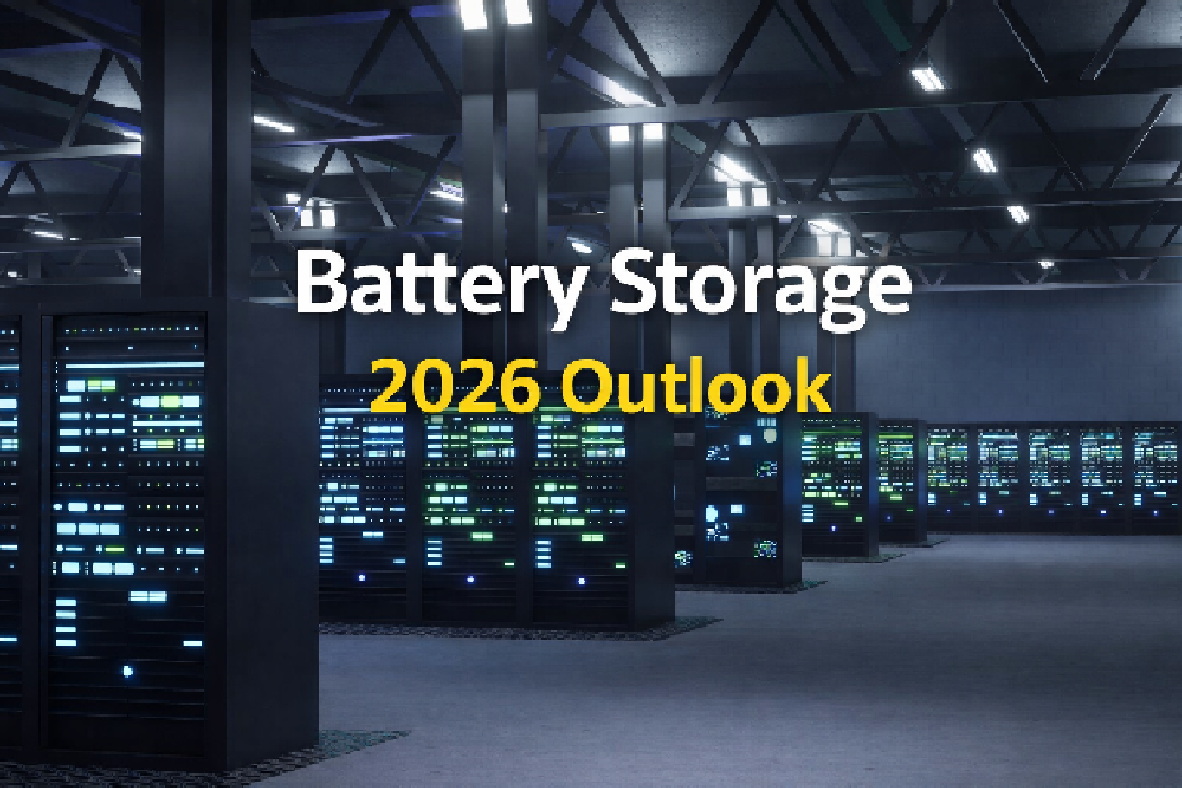
The most transformative demand driver of 2026 is the AI Infrastructure Supercycle. Historically, storage was used for grid balancing or renewable firming. Today, AI Data Centers (AIDCs) have become the industry’s most lucrative anchor tenants.
Interconnection Arbitrage
With grid interconnection queues now exceeding 36 to 48 months in many ISO/RTO regions, data center hyperscalers (Amazon, Microsoft, Google) are no longer waiting for the grid. They are partnering with developers to build “Private Wire” co-located storage.
- The Commercial Model: These assets are “behind-the-meter,” providing 24/7 firm power to AI training clusters while bypassing the traditional utility queue.
- The Premium: Data centers offer a higher PPA (Power Purchase Agreement) price than utilities because the cost of “downtime” for a multi-billion-dollar AI cluster far outweighs the marginal cost of the battery system.
Revenue Stacking: The Merchant Opportunity
Beyond data centers, the 2026 market has matured in its use of “Revenue Stacking.” Asset owners are no longer relying on a single contract. They are simultaneously bidding into:
- Energy Arbitrage: Charging during midday solar peaks and discharging during evening ramps.
- Frequency Regulation: Utilizing the millisecond response time of batteries to stabilize grid frequency.
- Capacity Markets: Securing fixed monthly payments for being available during peak demand events.